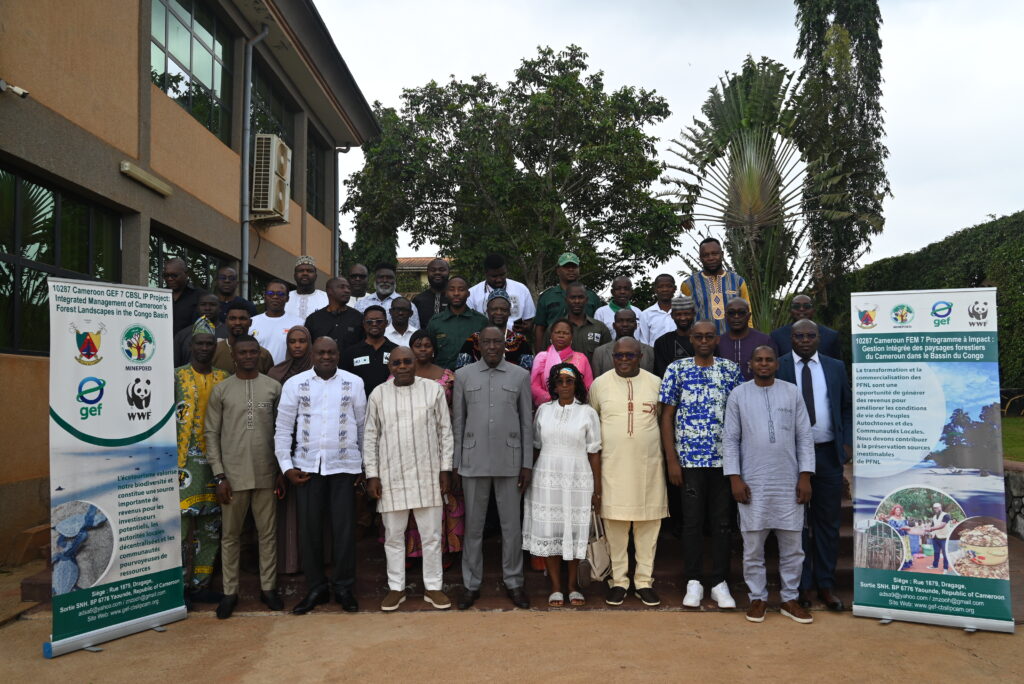
The review and planning workshop for the GEF 7 project “Integrated Management of Cameroon’s Forest Landscapes in the Congo Basin” concluded on Friday 24th July 2026 at the Welcome Garden Hotel in Soa after two days of deliberations. The event brought together all stakeholders of the Project around a common objective to assess achievements over the last year, capturing lessons learned, and charting the roadmap for the fifth year of the project.
Day 1 was devoted to presentations by the 11 implementing partners, covering all four technical components of the project. Component 1, focused on integrated land-use planning, featured interventions by (The National Observatory on Climate Change) ONACC and (Integrated Development and Management Program for the Dja Mining Loop and adjacent border zone) PADIDJA-PNDP, who presented their progress in integrating climate change into land-use planning tools.
Component 2, dedicated to forest governance and protected areas, took center stage. WWF Jengi TNS, WWF KZP (Kudu-Zombo Programme), AWF, (Bagyeli’s Cultural and Development Association) BACUDA, and (The Pygmy Concerted Action Research Network) RACOPY each presented their achievements in the Tri-National de la Sangha (TNS) and Tri-National Dja-Odzala-Minkebe (TRIDOM) landscapes. Discussions highlighted progress made in combating poaching, participatory protected area management, and the involvement of local communities.
Sustainable value chains which are at the heart of Component 3. Tropical Forest, (Network for NGOs in the South East) ROSE and (Support for the self-promotion of women in Boumba and Ngoko) AAFEBEN presented their work on developing Non-Timber Forest Product (NTFP) value chains, while UCLA-Taylor Guitars / (Congo Basin Institute) CBI shared their advancements in sustainable ebony value chain management. The exchanges underscored the importance of these value chains as a driver of economic development for forest-dependent communities.
Component 4, focused on sustainable tourism, featured presentations by (Community Research and Development Association) TUBE AWUE, WWF KZP, and (African Wildlife Foundation) AWF, who outlined ecotourism initiatives in the Campo Ma’an landscape and benefit-sharing mechanisms with local populations.
Day two was marked by a key moment which involved the Project Management Unit’s presentation of the findings and recommendations from the mid-term evaluation conducted in late 2025. This assessment helped identify areas for improvement and reorient certain actions to maximize the project’s impact during the remaining period.
In the second part of day two, participants were divided into component-based working groups for two intensive sessions. Group one for Component one which consisted of ONACC and PADIDJA-PNDP. Group two for Component 2 and 4 which consisted of WWF Jengi TNS, WWF KZP, BACUDA, RACOPY, TUBE AWUE and AWF. Group 3 for Component 3 which consisted of ROSE, AAFEBEN, Tropical Forest and UCLA-Tailor Guitars. This group session consolidated the results achieved, lessons learned, and key challenges encountered during Years 1 to 4 while deliberating and proposing on developing the Year 5 Annual Work Plan and Budget (PTBA 5), with particular attention to progress indicators, knowledge products, and means of verification. The exchanges allowed for adjustments to priorities, clarification of responsibilities, and collective validation of the upcoming activities schedule.
This GEF impact project, which aims to strengthen the biological integrity of Cameroon’s globally significant forests while improving the living conditions of local communities, now enters its fifth year. The achievements of the first four years in forest governance, sustainable value chain development, and ecotourism must be consolidated and sustained beyond the project’s closure.
The 38 participants, representing sectoral ministries (MINEPDED, MINFOF, MINAS, MINTOUL), technical partners (WWF, AWF, ONACC, RACOPY, ROSE, AAFEBEN, BACUDA, TUBE AWU, UCLA), and national park conservators, depart with a shared vision and a clear roadmap for Year 5.
“This workshop marks a crucial milestone in the project’s lifecycle. We have not only reviewed our actions but also laid the groundwork for a Year 5 that will be decisive for the sustainability of the project’s results and impacts,” said Mr. Adama Saïdou, National Project Director.
The PTBA 5, now adopted, will be submitted for approval to the Steering Committee before its effective implementation across the project’s three landscapes.