


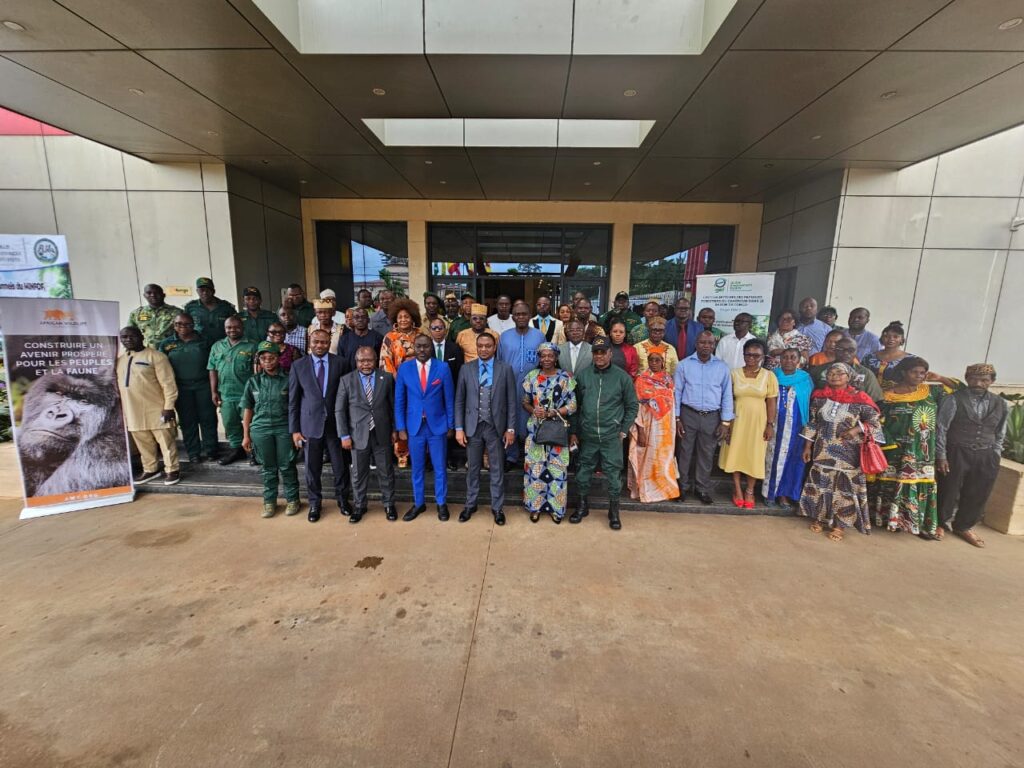
An advancement was made on July 21, 2026, for the conservation of one of Cameroon’s main biodiversity hotspots. Regional authorities, government officials, local communities, and indigenous peoples gathered in Ebolowa to validate the revised development plan for the Campo Ma’an National Park (PNCM), a protected area of 264,064 hectares originally created in 2000 as an environmental compensation measure for the Chad-Cameroon pipeline project.
The meeting, chaired by the governor of the South region, was organized by the Ministry of Forestry and Wildlife (MINFOF) with the technical and financial support of the GEF 7 Impact Project and the African Wildlife Foundation (AWF). It brought together a wide range of stakeholders, including representatives from central and decentralized MINFOF services, administrative authorities, local communities, the Bagyéli indigenous people, civil society organizations, and private sector actors operating near the park.
The validation workshop culminated a thorough participatory process that began in 2024. Following numerous consultations with local communities and indigenous peoples, the revised plan was submitted for municipal and departmental validation before reaching this stage. The main objective of the meeting was to review and approve the consolidated version of the document before it moves to the final approval stages.
The discussions focused on the orientations of the new management plan. Participants reviewed feedback from previous consultations and proposed amendments to strengthen the document. A central point of discussion was to ensure that the concerns of the Bagyéli indigenous communities, particularly regarding access to natural resources, benefit-sharing mechanisms, and the preservation of traditional livelihoods, were adequately addressed.
The GEF 7 Project played a key role in the discussions, emphasizing the integration of environmental and social safeguards, gender considerations, and the effective participation of women and youth in the governance of the park. Delegates highlighted the need for ongoing information sharing with neighboring communities and the establishment of transparent mechanisms to prevent and manage social risks arising from conservation measures.
At the end of the session, the participatory review process was fully presented and discussed, and stakeholder observations were examined. The validation was hailed as a success, strengthening the spirit of collaboration between the GEF Project and the institutions responsible for managing Campo Ma’an National Park.
For the future, recommendations addressed to the MINFOF and technical partners call for sustained dialogue with local and indigenous communities, rigorous enforcement of environmental and social safeguards, and improved communication throughout the implementation of the plan. Park managers were invited to establish a participatory monitoring framework, enhance the contributions of women and youth in governance, and ensure widespread dissemination of the approved plan among local actors.
As the revised development plan moves toward final approval, this validation marks an important milestone in Cameroon’s ongoing commitment to reconcile conservation with the rights and livelihoods of forest-dependent communities. The inclusive approach advocated during this process sets a promising precedent for the sustainable management of natural resources in the Congo Basin.




Leave a Reply