


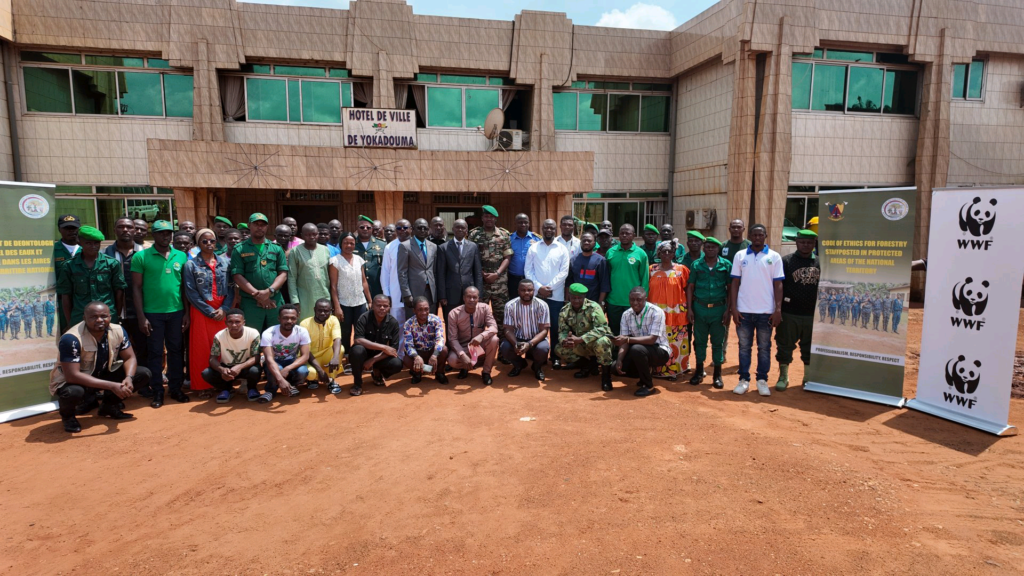
In a decisive move to reconcile wildlife protection with fundamental human rights, the Global Environment Facility (GEF 7), alongside the World Wildlife Fund (WWF), supported a landmark capacity-building workshop from June 3rd to 5th, 2026, in Yokadouma. The event brought together eco-guards and local community members from the Lobéké National Park (PNL) to tackle wildlife crime while ensuring that anti-poaching operations respect human dignity.
Hosted at the Yokadouma City Hall conference room under the auspices of Cameroon’s Ministry of Forests and Wildlife (MINFOF), the workshop marked a critical step in redefining conservation enforcement. For GEF 7, which provided technical and financial backing, the initiative reflects a core conviction which aims at protecting biodiversity and upholding human rights which are not opposing goals but mutually reinforcing imperatives.
The three-day session assembled an unprecedented cross-section of actors. Beyond PNL eco-guards and local community representatives, participants included officials from MINFOF central and decentralized services, the Ministries of Justice and Defense, the Directorate General for National Security (DGSN), the National Commission on Human Rights and Freedoms (CDHC), civil societies, forest concession holders (HAS & SEFAC), and technical partners.
Opening remarks set a firm tone. WWF’s Jengi-TNS Program Chief stressed that conservation must be guided by professionalism, fairness, and strict adherence to the law. The representative of MINFOF’s Boumba and Ngoko Departmental Delegate issued a clear reminder: public authority must only be exercised within the legal framework, urging field staff to internalize training tools so that enforcement actions remain both firm and respectful of human rights.
The workshop modules covered the dynamics of wildlife crime, step-by-step application of wildlife laws, human rights best practices in anti-poaching activities, and field experience sharing. However, the most valuable exchanges emerged from open floor discussions. Participants raised several pressing concerns:
· The absence of hunting zone representatives (ZIC). Despite being major stakeholders around protected areas, ZIC members are regularly missing from human rights training sessions, weakening efforts to prevent abuses.
· Human-wildlife conflict compensation. Clear procedures for compensating communities affected by wildlife damage remain unresolved.
· Perishable seizure management. Current protocols lead to value loss and foregone revenue; auction systems were proposed as a solution.
· Awareness of the 2024 forest law. Local communities around PNL have low levels of familiarity with the new legislation,thereby hindering appropriation and compliance.
· Mining and environment ministries. Participants called for their systematic inclusion in future workshops.
Under GEF 7’s watch, participants formulated actionable recommendations directed at MINFOF. These include: ensuring regular participation of hunting zone representatives; inviting mining and environment administration officials to future sessions; auctioning perishable seized products to prevent revenue loss; multiplying awareness campaigns on the 2024 forest law for riverine communities; and ensuring efficient recovery of damages and fines from forestry convictions. Critically, the monitoring of recommendation implementation must be inscribed on future workshop agendas.
The workshop also issued a direct appeal to partners like GEF 7 to support MINFOF in disseminating the new forest and wildlife law among local populations. For GEF 7, this aligns perfectly with our commitment to enabling conditions where conservation succeeds because communities are informed, respected, and engaged.
In his closing address, the representative of MINFOF’s Boumba and Ngoko delegate congratulated trainers and participants alike for their dedication and assiduity. He urged all learners to fully appropriate the training elements for efficient implementation of the workshop’s objectives.
At the end of the workshop, one message resonated clearly that is the fight against wildlife crime in Lobéké National Park will not succeed at the expense of human rights. GEF 7 remains proud and tightens her commitment to support this balanced, professional, and inclusive path forward.





Leave a Reply