


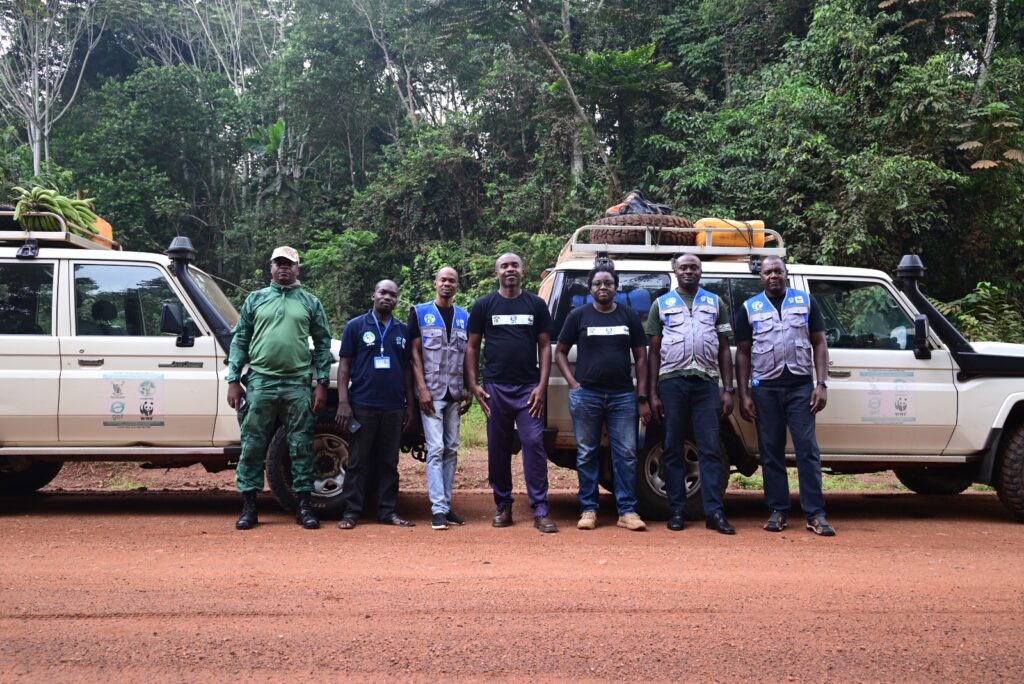
The GEF-7 Cameroon project team, alongside ministerial Focal Points from MINEPDED, MINFOF, and MINTOUL, have successfully completed an intensive joint mission across the TRIDOM, TNS and Campo Ma’an-Rio Campo landscapes. From June 17 to July 9, 2026, the multi-stakeholder team traversed beneficiary communities in Somalomo, Mintom, Ngoyla, Lomié, and Salapoumbe and more to evaluate progress, address challenges, and chart the path forward for sustainable forest landscape management in the Congo Basin.
The joint mission brought together experts from the Project Management Unit, which was made up of Financial Management, Monitoring and Evaluation, Landscape Officers and Communications alongside implementing partners Tropical Forest, AAFEBEN, ROSE, WWF, African Wildlife Foundation (AWF), Congo Basin Institute (CBI), and others. The primary objective was to assess implementation levels of the Impact Programme for Integrated Forest Landscape Management while ensuring alignment with the roadmaps of participating ministries.
This mission represents our commitment to transparency and collective stewardship, by bringing together government Focal Points and implementing partners, to ensure that our interventions are not only effective but also deeply rooted in national priorities and community needs.
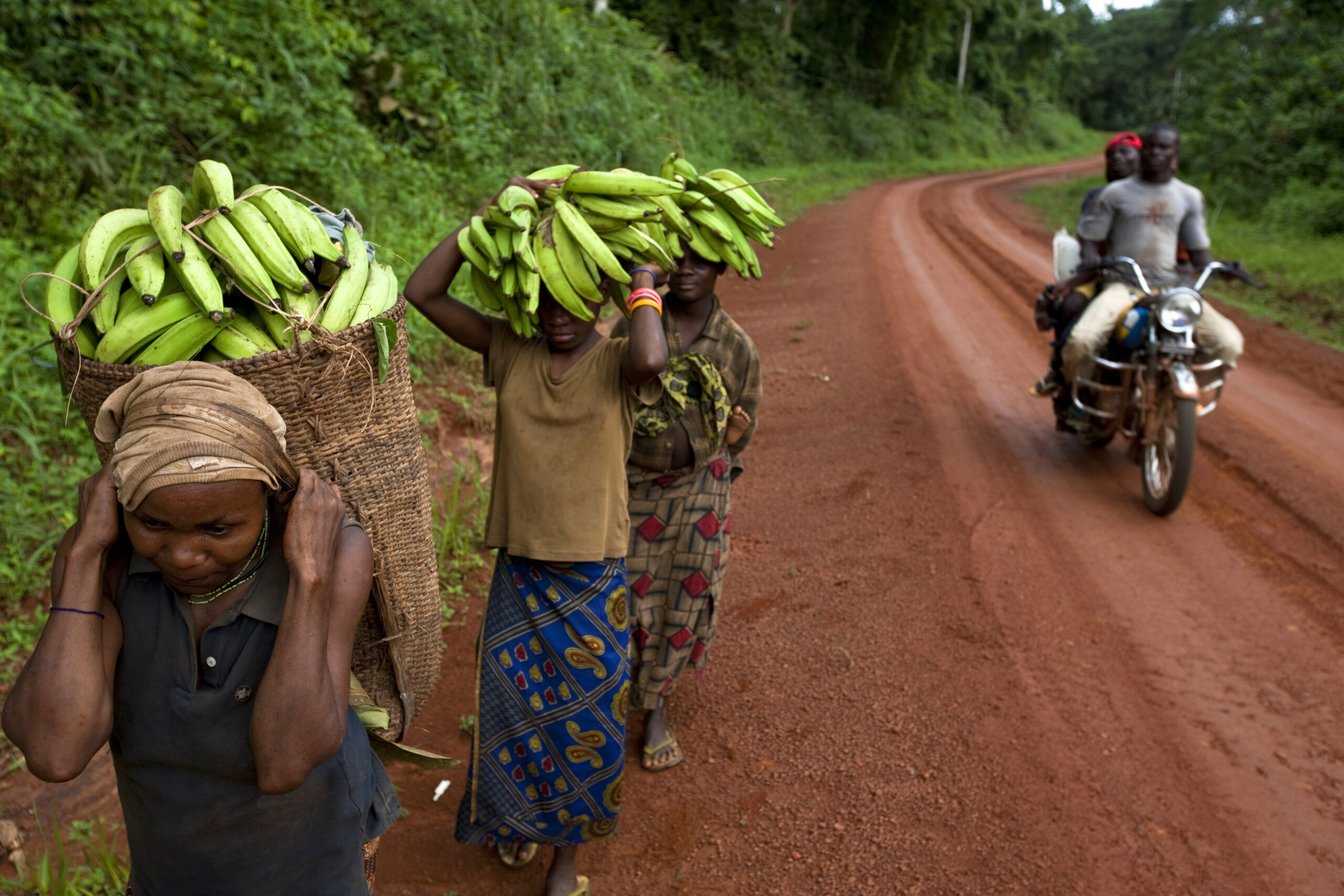
It revealed encouraging progress across multiple communities, particularly in the TNS landscape where participating groups demonstrated commendable financial health. In Salapoumbe, the GIC EVA of Lokomo recorded sales of 572 wild mango combos generating over 1.3 million FCFA, while ASDEFEBB of Malapa-Nguilili 2 successfully marketed 251 Djansang combos, earning 1.4 million FCFA.
Perhaps most inspiring was the testimony from Malapa-Nguilili 2 community members that attested that, the secret lies in collective action as both the Baka and Bantou of Malapa-Nguilili 2 camp together for NTFP collection. This collaborative spirit, where indigenous and local communities work side by side, exemplifies the inclusive approach at the heart of the GEF-7 programme.
In Lomié, the Cercle Vert cooperative demonstrated practical application of training received, successfully implementing new Djansang crushing techniques and maintaining significant stock of Moabi, wild eggplant, and other Non-Timber Forest Products (NTFPs). The cooperative now supports 7 Baka and 10 Bantou groups, showcasing the programme’s reach across communities.
The participation of ministerial Focal Points proved its validity to the project throughout the mission. The MINFOF Focal Point actively encouraged communities to engage in reforestation and NTFP tree domestication, even promising specific support to groups pursuing nurseries. Forestry officials urged communities to formalize their needs through written requests, ensuring proper follow-up and monitoring.
Collaboration between sectoral administrations was reinforced, with social affairs representatives confirming successful Baka-Bantou cooperation in multiple communities. This inter-ministerial engagement demonstrates the holistic approach required for sustainable landscape management, addressing not only environmental concerns but also social inclusion, economic development, and governance.
The mission also identified exciting opportunities for synergy, particularly regarding CBI’s (through IITA) intervention in the same TNS communities under the INFORBIO project. Communities have expressed strong interest in NTFP nurseries particularly for Djansang, wild mango, Moabi, and Kanda and inter-project collaboration offers a viable path forward.
Another critical recommendation involved establishing multi-stakeholder platforms to connect producers with buyers, ensuring communities can market their NTFPs effectively and capture better value. This aligns with the project’s objective of creating sustainable economic opportunities for forest-dependent populations.
A comprehensive monitoring plan has been developed based on mission findings.
Key priorities include:
· Financial management training for all partners, focusing on proper record-keeping and fund separation
· NTFP processing support, including equipment maintenance and sharing of best practices
· Reforestation acceleration through establishing nurseries in communities expressing interest
· Strengthened collaboration between implementing partners and local administrations
· Enhanced visibility to ensure communities recognize GEF-7 programme contributions
The mission concluded with a renewed commitment to the programme’s vision strengthening integrated management of Cameroon’s globally significant forest landscapes to ensure biological integrity while increasing economic opportunities and livelihoods for forest-dependent peoples.
We celebrate the dedication of communities, partners, and government officials who are working together to preserve Cameroon’s natural heritage for generations to come. The road map toward sustainable forest landscape management continues, and with collective effort, we are building a resilient and prosperous future for our country and the entire globe.




Leave a Reply